
AGENT INSFRASTRUCTURE
The reasoning layer
the agent economy runs on.
SERV turns frontier models into production-grade agent infrastructure. Structured reasoning, model routing, and audit-ready execution. OpenAI SDK-compatible. No vendor lock-in.
In production with




The SERV agent infrastructure stack.
Reasoning, routing, deployment, and audit in one layer.
The one-line API is only the entry point. SERV is the execution layer underneath production agents: how work is decomposed, routed, validated, launched, and operated.
🍔 Our Publications
Start with the reasoning engine. Expand into the full agent economy.
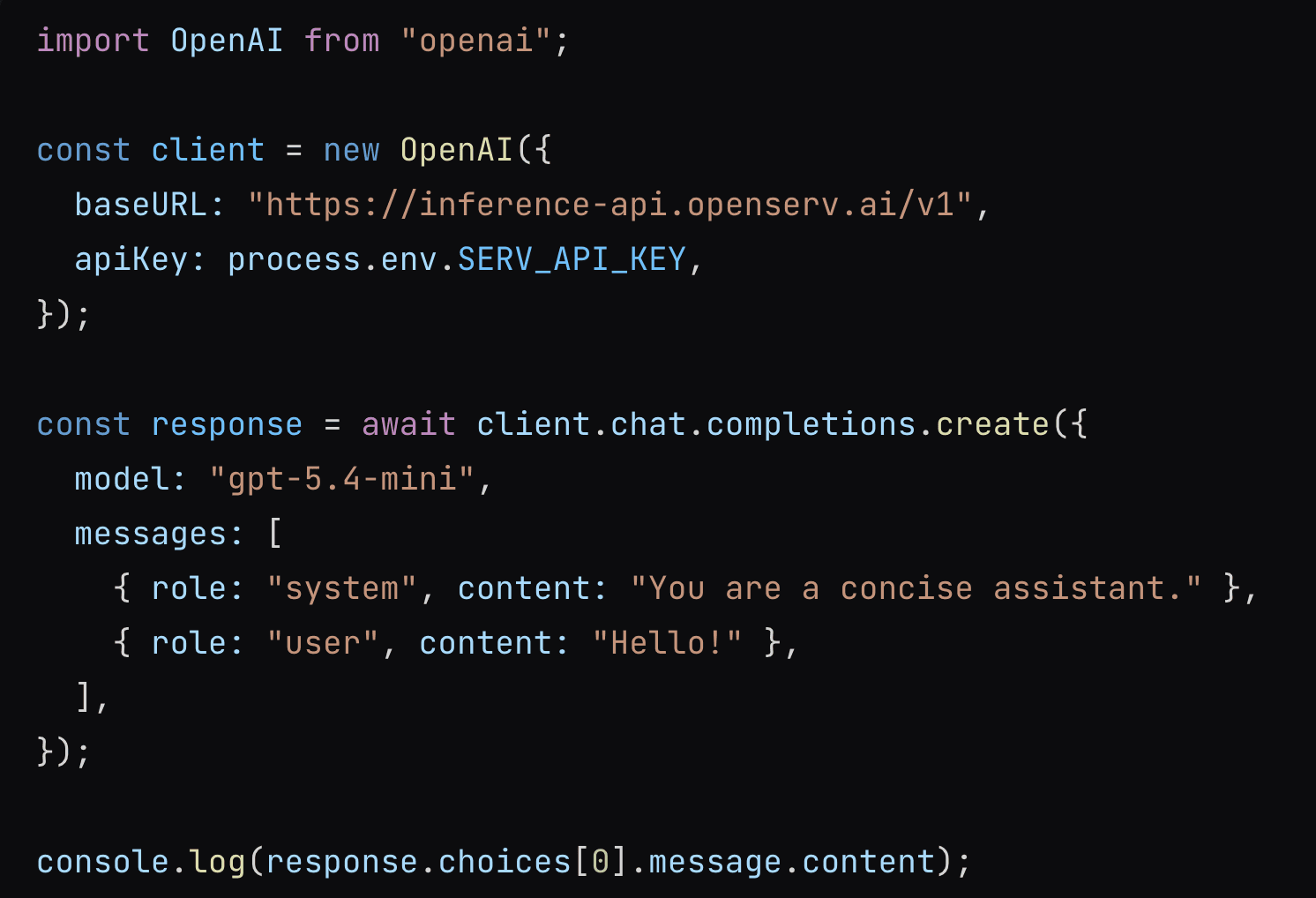
Swap one line.
Keep your agents.
OpenAI- and Anthropic-SDK compatible · 2-minute integration · No vendor lock-in
OpenAI SDK
Anthropic SDK
OpenAI
Imagine an AI agent designed to assist in writing an article about sustainable living. It starts by collecting data from reputable sources like environmental blogs, research papers, and expert interviews. Then, it analyzes this information to uncover trends.
Production signals
from SERV Reasoning users.
Lower cost, fewer failed calls, and more reliable execution across real agent workloads.
0x
0x
performance-per-dollar
Independent benchmark signal against frontier-model baselines.
10
10
failed calls
Private-beta production workload with no failed calls recorded.
0%
0%
cost reduction
Lower inference cost while preserving agent output quality.
Compliance & security.
Built for procurement, not promises.
The same reasoning layer that lowers cost also creates the audit surface enterprises need before agents can enter regulated workflows.
V 2.1
TEE + E2EE
Trusted-execution-environment private inference for regulated data.
NEXT
V 2.4
Graph Sharding (Audit)
Every reasoning step traceable. Audit-grade decision trails.
NEXT
-
SOC 2
Type I targeted Q3 2026 · Type II Q1 2027.
IN PROGRESS
-
Data residency
EU, UAE, and on-premise options for enterprise contracts.
AVAILABLE
Why this exists
Agents don't fail because the model is weak.
They fail because the execution layer is missing.
Multi-step workloads need routing, validation, memory boundaries, retries, audit trails, and cost control. Frontier models alone don't provide the operating layer agents need. You cannot prompt your way out of an inference layer that wasn't designed for the workload.
No validation contract
Prompts do not enforce production behavior.
Enterprise workflows need structured outputs, failure handling, and repeatable reasoning paths instead of best-effort prose.