SERV Reasoning
Production-grade reasoning,
one line of code.
The reasoning engine that sits between your application and any frontier model. Same SDK, same prompts — at a fraction of frontier model cost, with reliability that survives procurement.
Frontier models break in production.
Every enterprise hits the same three walls.
Reliability
0%
0%
of enterprises achieve measurable AI ROI on the majority of their projects.
IDC, 2026
Production agents fail differently than chatbots. Hallucinations compound. Retries spiral. Demos don't survive deployment.
Cost
$0K
$0K
Per agent per month at full frontier pricing.
Internal benchmarks
One human request becomes hundreds of model calls. At agentic scale, the math doesn't work
Auditability
10/N
10/N
regulated procurement gates that frontier APIs clear.
Healthcare, finance, gov, defense
They need every reasoning step traceable. Frontier APIs don't give you that.
You cannot prompt your way out of an inference layer that was not designed for the workload.
Three mechanisms.
One reasoning architecture.
These mechanisms are the productized form of BRAID — published at arXiv:2512.15959. Currently in peer review.
Bounded reasoning graphs
Tasks decompose into structured steps with explicit dependencies. Each step has a defined input schema, output schema, and validation contract. The model can't wander because the graph won't let it.
Schema-forced execution
Outputs conform to specifications, not arbitrary prose. Parse failures disappear. Latency drops. Reasoning tokens stop multiplying without constraint. Most of the cost was hiding here.
Intelligent model routing
Easy work goes to cheaper models. Specialized work goes to specialists. Frontier models only fire where they actually matter. The frontier isn't the problem. Calling the frontier for every step is the problem.
Model Catalogue
Multiple SERV-Reasoning classes, one API. Pick the tier each workload deserves, swap to SERV-enabled frontier models freely.
Verification and Prompt Protection Layer
Every output validated before it leaves - the audit-grade trail regulated industries require.
Graph Creation vs Execution
Planning relies on frontier models, repeatable execution leans on smaller models.
Schema-Forced Execution
Outputs conform to specifications, not arbitrary prose. Parse failures vanish; latency and cost drop.
Bounded Reasoning
Tasks decompose into structured steps with explicit dependencies.
Where the savings actually live.
Five workload shapes that account for the curve.
01
Agent loops with tool calls
10K+ queries/day. Long chains amplify every cent of inference cost
~30-100× cost reduction
02
Classification, extraction, routing
High volume, narrow output. Frontier models are massive overkill.
~74× cheaper at parity
03
Repeated workflows
Invoice processing, support triage, document QA — same shape, different inputs.
~80-90% cost cut observed
04
Structured generation
JSON outputs, function calling, schema-bound responses. Where parse failures live.
~0% parse failure rate
05
Plan-then-execute pipelines
Strong model plans, cheap model executes. The economic split that makes the math work.
best-in-class on multichallenge benchmarks
Same SDK. Same prompts.
Different brain.
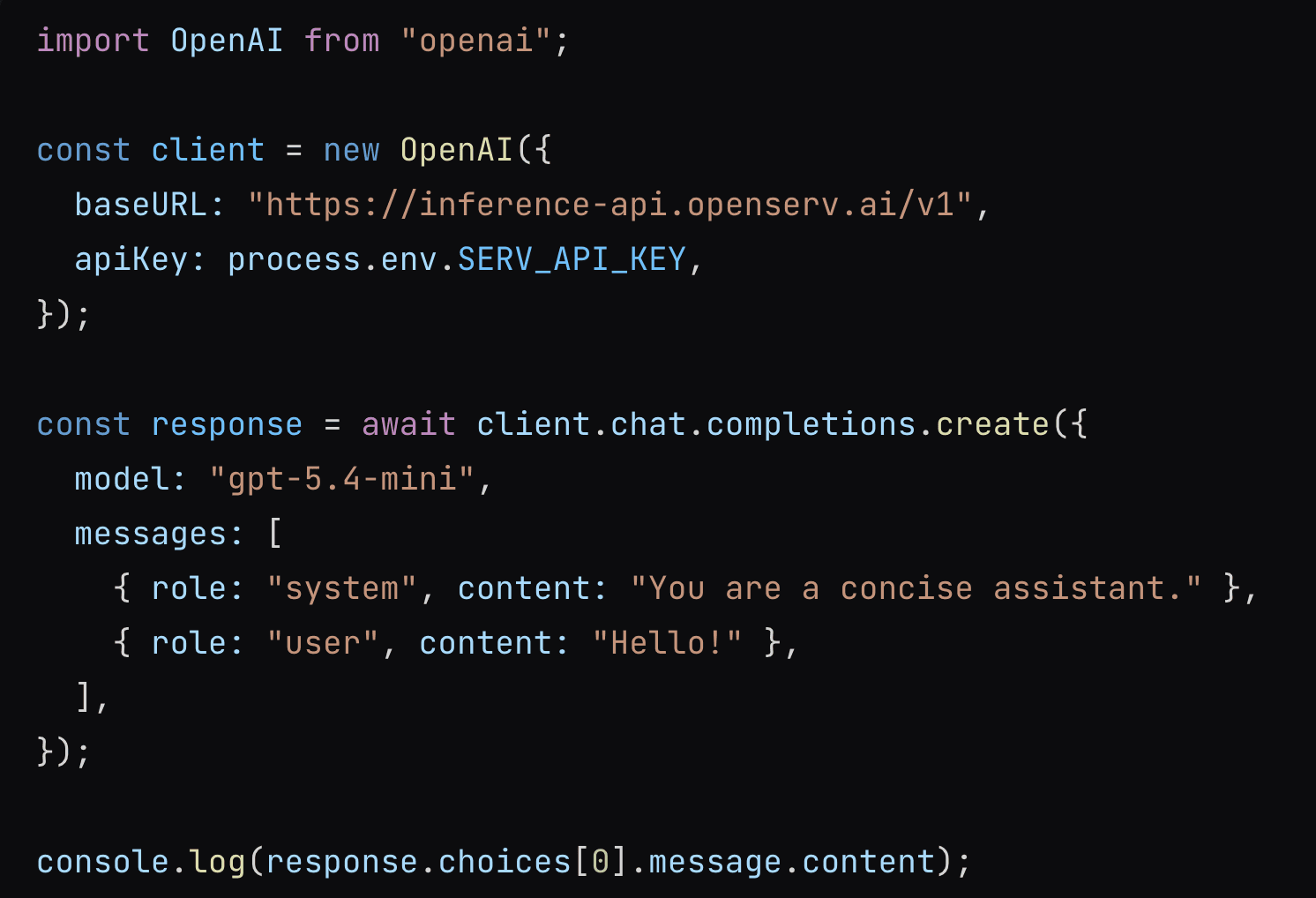
OpenAI
The entire installed base of LLM-powered software is addressable without rebuild cost.
OpenAI SDK-compatible
Anthropic SDK-compatible
2-minute integration
No vendor lock-in — swap any frontier model, keep the reasoning layer
Six models.
Pick the tier the workload deserves.

Tier 1
serv-nano
Price (in / out per 1M tokens)
$0.05 / $0.20
Use cases
Classification, routing
Tier 1
serv-mini
Price (in / out per 1M tokens)
$0.12 / $0.48
Use cases
Extraction, summarization
Tier 2
serv-standard
Price (in / out per 1M tokens)
$0.40 / $1.60
Use cases
General agent workloads
Tier 2
serv-pro
Price (in / out per 1M tokens)
$1.20 / $4.80
Use cases
Plan-then-execute, complex tools
Tier 3
serv-ultra
Price (in / out per 1M tokens)
$3.00 / $12.00
Use cases
Frontier-quality reasoning
Tier 2
serv-swift
Price (in / out per 1M tokens)
$0.30 / $1.20
Use cases
Latency-critical verification
Get started.
Three steps to ship.
Step 2
Point your SDK at SERV
Change the base URL. Keep your prompts.
Step 3
Ship
Reasoning, schema-bound and routed, in production.