Tech Insight
First independent SERV benchmark
Zero failures. 100x cheaper.

The First Independent SERV Reasoning Benchmark: 100x Cheaper, Zero Failures
The first user-published benchmark from the SERV Reasoning private beta just landed, and it came from a customer, not from us. ThoughtProof, a verification infrastructure company building for banking, model risk management, healthcare, and on-chain settlement, ran SERV Reasoning against the production stack it was already using and published the full methodology.
The headline numbers:
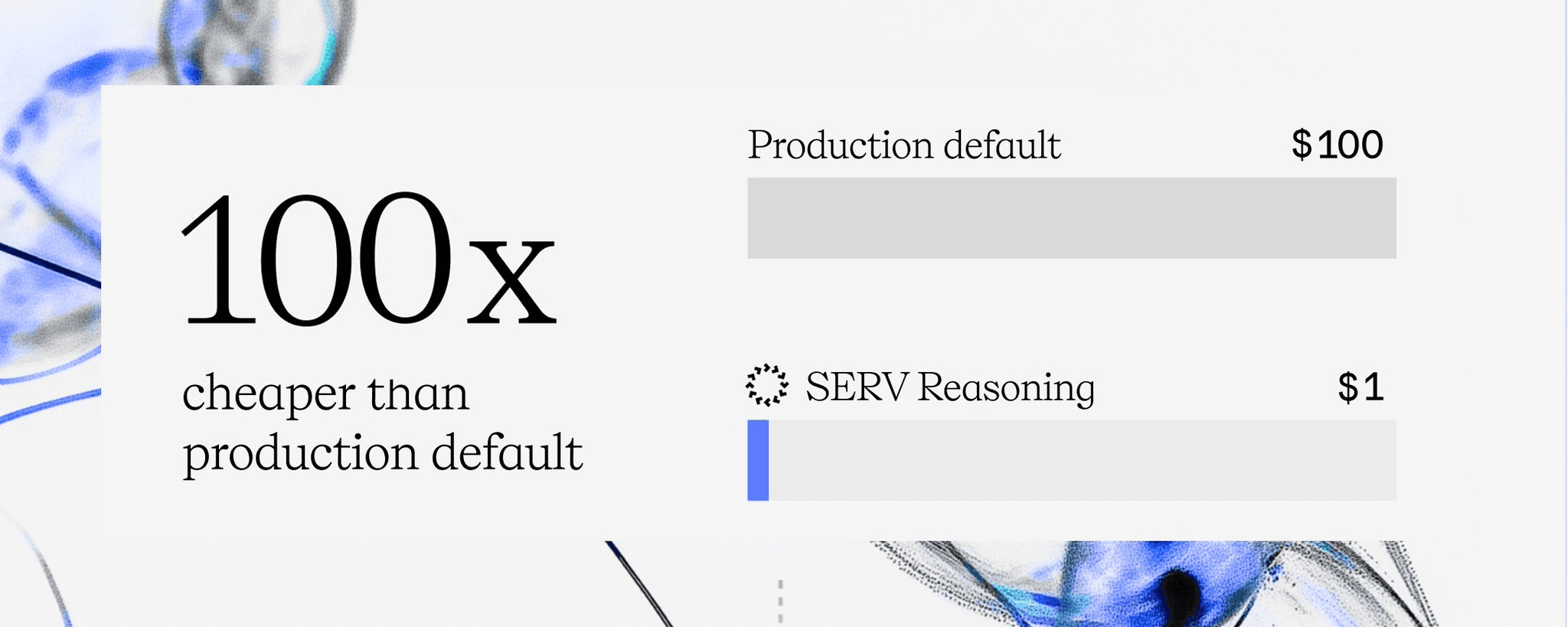
100x cheaper per call than their prior production default
107x better accuracy-per-dollar versus baseline
Zero failed calls and zero false approvals across 120 cases
Here is why those numbers matter, in ThoughtProof's own words and ours.
Why verification is the hard problem
Verification is one of the hardest unsolved problems in agent deployment. Nobody ships production agents in banking, healthcare, or on-chain settlement until they can prove the agent's reasoning is sound. And the math on verifying every agent step has been economically broken from day one: at roughly $0.06 per verification call, you simply cannot afford to check every plan a multi-agent system produces.
SERV Reasoning changes that math. That is the real story underneath the headline.
What ThoughtProof tested
ThoughtProof runs Plan-Level Verification (PLV): it takes a complete plan and execution trace from an AI agent and verifies whether the trace is faithful to the plan, evidence-supported, and free of unsupported leaps. This is the verification surface regulated teams ask for. Banking model risk management needs reproducible, auditable verdicts. EU AI Act compliance requires documented evaluation of high-risk systems. On-chain settlement needs deterministic verdicts before money moves.
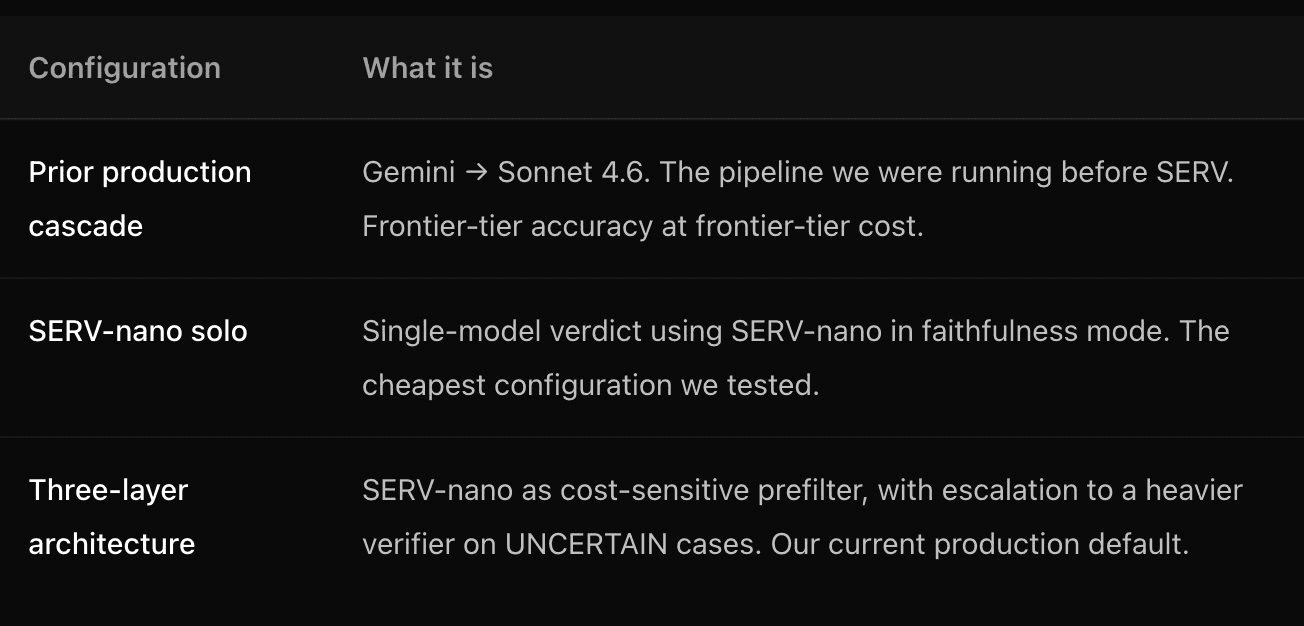
The benchmark was 120 cases drawn from production-shape workloads across finance, risk, healthcare, and code, with gold labels curated against ground truth, run in faithfulness mode. ThoughtProof compared three configurations against the same cases, same labels, same 48-hour window.
The cost result: a different regime, not an iteration
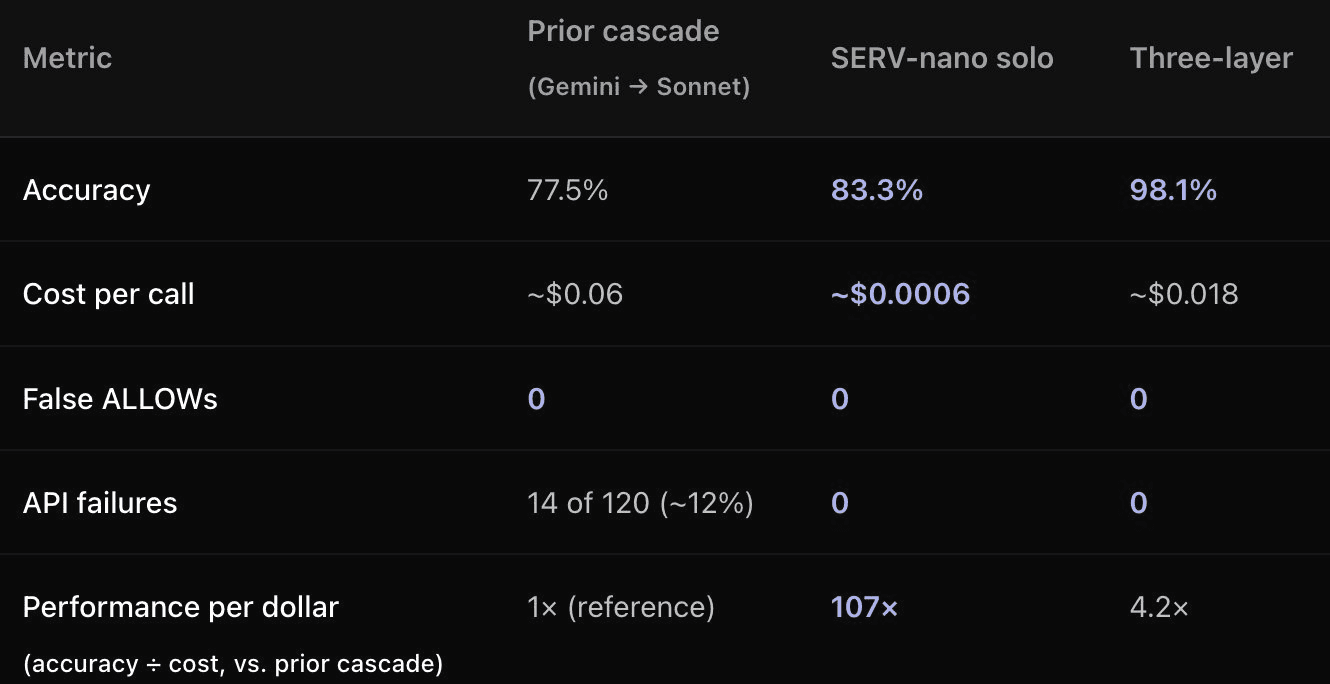
SERV-nano solo beat ThoughtProof's prior Gemini-to-Sonnet cascade on accuracy (83.3% vs 77.5%) at one-hundredth of the per-call cost ($0.0006 vs $0.06). That accuracy-per-dollar ratio is where the 107x figure comes from.
In their words, this is not an iteration, it's a different cost regime, and it changes what you can afford to verify.
The accuracy result
ThoughtProof's production default is a three-layer configuration: a SERV-nano prefilter with escalation for uncertain cases. It reaches 98.1% accuracy, a 14-point lift over the baseline, at $0.018 per call, still roughly 3x cheaper than the prior cascade. SERV-nano solo, at 83.3%, is the conservative cheaper tier: when uncertain it tends to block, which is safe but produces more over-blocks. Both are in front of their customers. As ThoughtProof puts it, the choice between them is a UX-versus-cost call, not a safety call, and the reason it is not a safety call is the next number.
The number that actually decides production
Both SERV configurations hit zero false approvals across all 120 cases. In a compliance context, that is the metric that should land hardest. A false approval means the verifier said it was safe to settle when it wasn't, a regulatory consequence. A false block just means "double-check this," a minor friction. They are not equally weighted, so the right metric for a compliance-grade verifier is cost-per-compliant-call with false approvals held at zero. Both SERV configurations clear that bar.
But the prior cascade failed a different one.
The reliability failure nobody benchmarks
On the same 120 cases, in the same week, the prior cascade hit 14 API failures, every one an upstream 503 on the Gemini layer. That is a 12% failure rate on a verifier stack. SERV ran clean: zero failures.
This is easy to underrate, because most cost and accuracy benchmarks don't include availability. But for a verifier gating a settlement workflow, it is the failure mode that decides whether the system is production-grade. When an upstream verifier fails, every option is bad: retrying stacks 5 to 15 seconds onto the call and risks a missed deadline; failing open writes "ALLOWED" into your audit trail for calls that were never verified; failing closed shows users blocks that are really outages in disguise, spiking support tickets.
For banking and model risk management, this is the difference between "audit trail on every transaction" and "audit trail when the API was up." That is a hard regulatory requirement. An evaluator that drops 12% of calls is not a production option in compliance contexts, even if its accuracy is identical.
The bigger implication: verification cheap enough to run everywhere
There is one more thing the cost number unlocks that isn't visible in the results table. At $0.0006 to $0.018 per call, plan-level verification moves from an enterprise compliance checkpoint into the same cost tier as a single agent reasoning step.
Previously, verification was cost-gated to high-value transactions, because at $0.06 a call you couldn't afford to verify every plan revision a multi-agent system produces. With SERV in the stack, that constraint disappears. This opens a category that was priced out before:
Multi-agent orchestrations that verify each other's plans before executing tools
Long-horizon agents that re-verify their own plans on each major revision
Pre-tool-call validation gates for high-cost or high-impact actions
This isn't cheaper verification for the same compliance use case. It's verification becoming affordable enough to run inside the agent loop itself, a category that was economically infeasible before SERV's cost structure showed up.
Why these numbers hold
ThoughtProof was careful about rigor: all three configurations ran within a 48-hour window against the identical case set, and they note that single-run results carry 3 to 5 points of accuracy noise, so smaller differences shouldn't be over-read. The 14-point accuracy gap and the 14-versus-0 API-failure gap are both well outside that band.
SERV Reasoning is still in private beta, and these numbers are from that beta. ThoughtProof expects them to hold at general availability, because the architectural reasons SERV-nano is fast and reliable, being purpose-built for verification rather than general-purpose chat, don't change at GA.
You can read ThoughtProof's full methodology and results on their blog. It is the first independent benchmark of SERV Reasoning, and it points at exactly the thing enterprises say they need before they deploy: reliability they can prove, at a cost that finally makes proving it possible.
🍔 Our Publications
Announcement
SERV Roadmap
Feature
Benchmark Tooling: Proof on Your Own Agents Before You Migrate
Article
SERV's Path Into Banking and Financial Services
Feature
PromptGuard: Prompt Injection Protection Built Into the Reasoning Process
Feature
Multipath: Structured Reasoning for Agents That Outgrew a Single Prompt
Feature
Shadow Agents: Autonomous AI Agent Verification, Built for Production
Article
The SERV Vision and Roadmap
Tech Insight