Feature
Shadow Agents
Autonomous AI Agent Verification, Built for Production

Shadow Agents: Autonomous AI Agent Verification, Built for Production
AI agent verification is the difference between an agent that works in a demo and one a bank will actually deploy. Getting an agent to produce an answer is only part of the work. The harder question, the one that decides whether an agent can go into a regulated environment at all, is this: how do you know the output actually conforms to what you expected? Not usually. Not in a demo. On this call, and the next ten thousand.
Shadow Agents are the answer, and the cornerstone feature shipping in SERV Reasoning v2. They are autonomous verification agents that check every output against expectations before it ships, switched on with a single parameter on any SERV Reasoning API call. After nearly two years of research and development, they are finally leaving the lab.
Two years of hardening against real traffic
Shadow Agents have been one of the most intense R&D programs inside OpenServ, not a single feature but a concept central to the pursuit of reliable agents. The only way to make autonomous verification real was to test it where it matters: in production, inside live multi-agent orchestration.
Alpha and beta versions of Shadow Agents ran against real workloads on the OpenServ orchestration platform. Every failure mode, every coordination pattern that broke, every edge case no benchmark contains, all of it went back into the system.
This is where much of the industry is arriving now. Everyone likes talking about reasoning, auditability, verification, and judge models. Reliable judges are easy to prototype and brutal to turn into a product. Many teams have their own homegrown attempts, and other projects are now building versions of the same idea. What none of them have is years of hardening against live multi-agent traffic. That exposure is difficult to reproduce, and it is a core part of what makes SERV Reasoning hard to copy.
Why banks and enterprises need it
Enterprise trust has a specific shape, and it is not flashy demos. It is reliability and accountability.
Reliability means the output conforms to the specification, on this call and the next ten thousand. Accountability means that when someone asks why the system did what it did, there is a better answer than "the model said so," especially in regulated environments like banking.
Shadow Agents deliver both. Every response is independently checked against expectations before it ships, and every check is a process step you can point to. The output is not just generated. It is verified by a system that learned what failure looks like from years of real agent traffic, not from synthetic benchmarks.
The hidden cost they remove
SERV Reasoning already helps teams cut inference cost and improve performance. Shadow Agents go after a different cost, the one that never shows up in a model comparison chart: engineering time.
Writing system prompts for reliable agents is hard. You can describe what you want, but at production level you also need to know whether the output actually followed those expectations. So every serious team ends up building its own verification stack: eval harnesses, judge pipelines, retry logic. That is months of expensive engineering that produces zero visible product and is full of dead ends.
Shadow Agents replace all of it with a single toggle. Good engineering talent is scarce, and this hands it back.
There is also simpler failure math. An error caught in the shadows costs a retry. The same error caught in production costs rework, escalation, human review, and in some industries, a headline when agent mistakes cause real damage.
How it works
The API shape is much closer to how agent APIs should work:
text in -> reasoning -> autonomous feedback via Shadow Agents -> repeat until the output is right -> expected text out
The model still generates the response. Shadow Agents make sure it conforms to what was expected, and if it does not, feedback goes back and the model tries again, before anything reaches your system. The developer just enables it with a parameter on the API call.
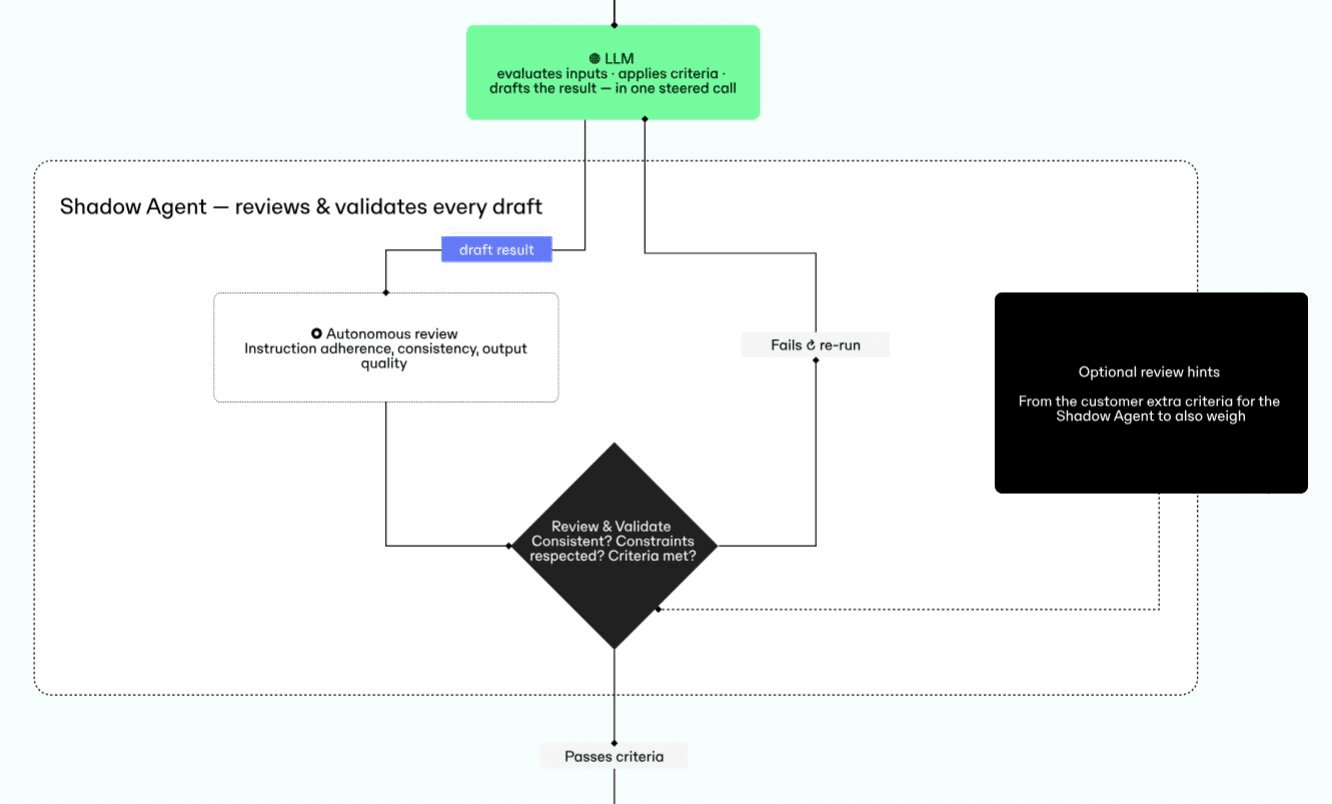
That simplicity is the point. The interface is one flag. Underneath it is two years of learning about how verification actually behaves inside multi-agent systems. The complexity is absorbed so you do not have to re-engineer it.
Steerability comes through a separate v2 feature shipping alongside Shadow Agents: Verification Hints. Instead of playing prompt word games and obsessing over exact phrasing, you tell the system what matters to your product, and Shadow Agents coordinate accordingly.
What this means in banking and robotics
In banking, a wrong output is not a bad user experience, it is a compliance event. Every automated decision needs to be explainable, and every output needs to have followed policy before it touches a customer or a ledger. Shadow Agents turn that from a review process into a property of the system: conformance checked on every call, in the flow, with the check itself part of the record.
In robotics the stakes are equally high but physical. An output is not a paragraph, it is an instruction that becomes motion, and a malformed instruction is not a typo, it is a safety incident. There is no human sitting between the model and the actuator, so verification has to happen at machine speed. Shadow Agents are that verification.
Different industries, shared requirement: "usually works" is not enough.
Why agent fleets end up here
Every enterprise and government roadmap now contains the same phrase: fleets of AI agents. What the roadmaps skip is that an unsupervised fleet is a liability multiplier. One agent making one error is an incident. A thousand agents compounding each other's errors at machine speed is a very bad quarter.
Human review scales to about four or five agents. It does not scale to five thousand. The only supervision that scales with a fleet is supervision that runs inside the fleet, at the same speed, on every call. That is what Shadow Agents are: supervision as infrastructure.
This is not something you can ship overnight. It comes from exposure, from watching real agents fail in ways no spec anticipated, inside real multi-agent systems, and teaching verification to catch it.
The thesis
Reasoning is a process, not next-token generation. Shadow Agents are the next component of that process to come to life, raising the reliability and accountability of every agentic system running on SERV.
This is why we believe every bank, enterprise, and government running agent fleets will run them on SERV Reasoning. Not because the models are smarter, but because the process behind them is accountable, and accountability is what enterprises actually ask for.
Shadow Agents ship with SERV v2.
🍔 Our Publications
Announcement
SERV Roadmap
Feature
Benchmark Tooling: Proof on Your Own Agents Before You Migrate
Article
SERV's Path Into Banking and Financial Services
Feature
PromptGuard: Prompt Injection Protection Built Into the Reasoning Process
Feature
Multipath: Structured Reasoning for Agents That Outgrew a Single Prompt
Article
The SERV Vision and Roadmap
Tech Insight
First independent SERV benchmark
Tech Insight