Tech Insight
September 5, 2025
BRAID is the Missing Piece in AI Reasoning
Models continue to get bigger, but not necessarily smarter.
There’s a super strange paradox at the center of AI right now.
Models continue to get bigger, but not necessarily smarter.
We’ve built towering skyscrapers of text prediction, and yet when you hand one of these giants a problem that requires more than three or four steps of actual logic, the cracks start to show.
Last year, MIT researchers pointed out that the reasoning skills of large language models are often overestimated because they excel at pattern-matching familiar problems but flop on novel ones, revealing that what looks like logic is often just memorized tricks.

CSAIL from 2024 research highlights how LLMs excel in familiar scenarios but struggle in novel ones, questioning their true reasoning abilities versus reliance on memorization.
Even a recent Nature study echoes this; showing that larger, more instructable models actually become less reliable, amplifying biases and inconsistencies in reasoning.

Scale has become the default answer. More data, more compute, more parameters. But at a certain point, you realize you’re piling floors onto a building without fixing the foundation. Or hiring 100 six-year-olds to do the work of a seasoned professional.
The truth is, reasoning, the ability to break a problem into steps, follow a process, and arrive at the right outcome, matters more than scale. Without it, you’re left with an eloquent guesser.
Apple's machine learning team nails this in their analysis: reasoning models hit a wall on complex problems, with accuracy collapsing despite extra compute, proving scale alone can't conquer actual logic.
That’s the gap BRAID was designed to close.
What BRAID actually is
With BRAID, machine-native reasoning has been solved.
BRAID, short for Bounded Reasoning for Autonomous Inference and Decisions, is a structured reasoning framework developed by our research team at OpenServ. Instead of asking a model to “think out loud” in natural language (the typical Chain of Thought approach), BRAID requires the model to produce a Guided Reasoning Diagram (GRD): an explicit, machine-readable flowchart that maps the solution before it even tries to solve the problem.
Step one: generate the plan as a diagram. (Ideally, this is written by hand and provided to the agent, instead of a lengthy system prompt.)
Step two: Execute the plan.
It sounds simple. But that separation — understanding versus execution — changes everything.
Where text drifts, diagrams hold steady. Where natural language can ramble into hallucinations, a bounded graph forces precision. The model is no longer improvising in prose; it’s following a blueprint.
This directly tackles enterprise fears: Deloitte reports that 77% of businesses are concerned about AI hallucinations, which erode trust in scaled-up models.
OpenServ is currently conducting enterprise pilots with publicly traded organizations and will announce updates within the next 30 days.
Numbers for doubters
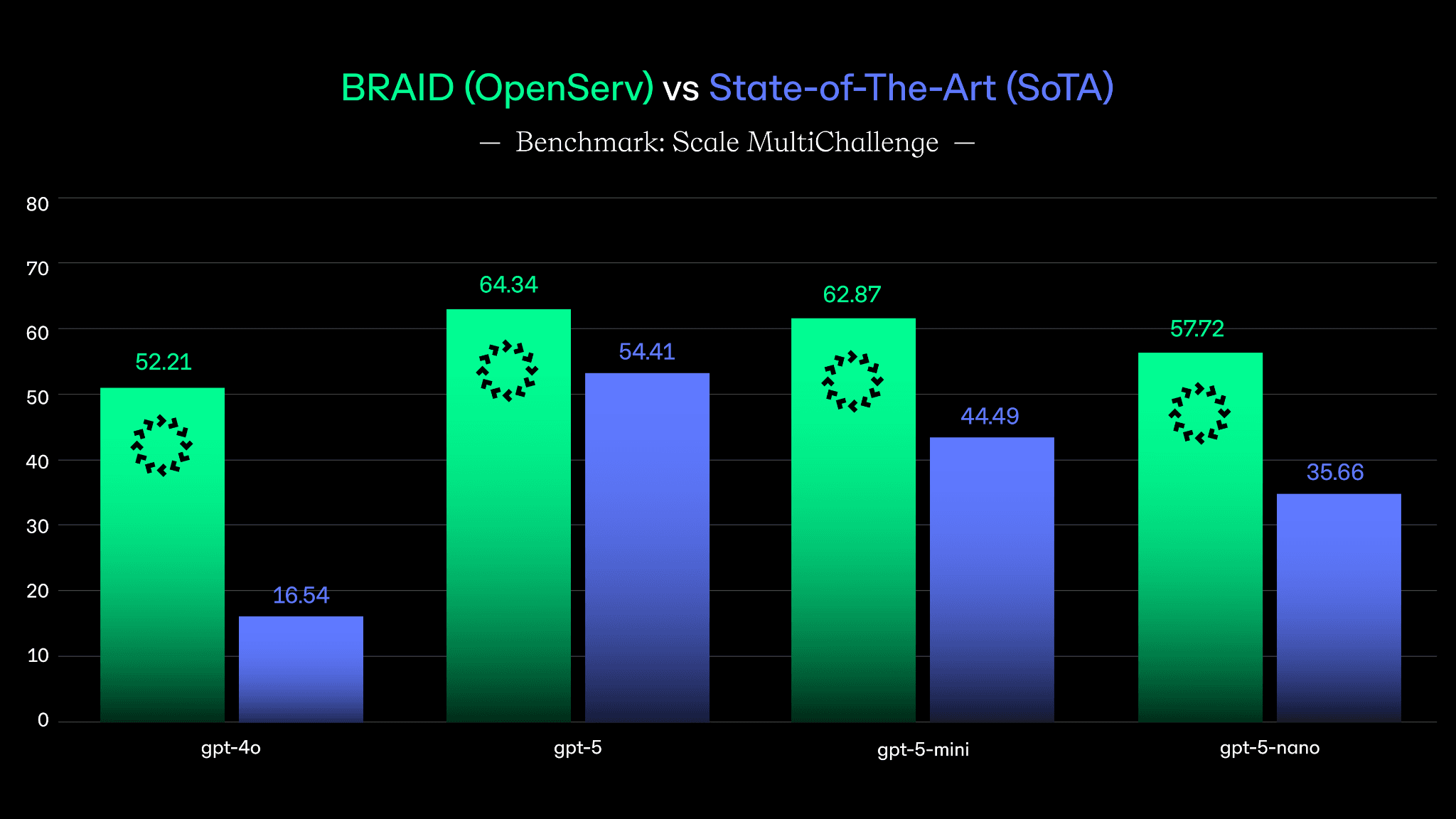
On GSM8K, an industry-standard benchmark of grade-school math word problems, GPT-4o by itself correctly answered 42 out of 100 questions. With BRAID layered on top, the same model hit 91 out of 100. That’s not a rounding error, that’s a shift from coin-flip reliability to near-expert consistency.
And while math is a convenient way to measure reasoning, the implications run far wider. Business process automation. Financial workflows. Complex troubleshooting. Anywhere you need a system to follow the rules, not invent them. Yet, as McKinsey's latest survey shows, only 1% of companies feel mature with AI deployment, bogged down by scaling pitfalls like unreliability—BRAID's structured approach could flip that script.
Okay, but how does this SERV me?
BRAID is informing the architecture of OpenServ's entire platform
For developers, it means agents you build on OpenServ will be able to handle complex, rules-based tasks without crumbling under ambiguity. Debugging becomes straightforward because you can see exactly where the reasoning went wrong, in the plan or in the execution. McKinsey also highlights a key hurdle here: 47% of C-suite leaders say they're releasing GenAI tools too slowly due to talent gaps and risks—BRAID's auditable diagrams could accelerate that by making reasoning transparent and fixable.
For users, this means trust. You’ll be able to see the “proof of reasoning” before an agent acts, making the process auditable instead of opaque.
For the industry, it marks a pivot away from chasing bigger models toward building smarter reasoning layers.
The bigger picture
The question is: do you want "AI" or actual AI with reasoning?

If language models are great storytellers, BRAID makes them competent problem solvers. The model is free to imagine possible pathways during planning, but once the diagram is drawn, it’s bound to follow the logic. That discipline reduces hallucinations, increases predictability, and most importantly, allows AI to be trusted in settings where wrong answers have real costs.
Reasoning, not scale, is the missing piece. BRAID is our endeavor to put that piece firmly in place.
To learn more, join the conversation on our Telegram channel or visit openserv.ai.
References
Larger and More Instructable Language Models Become Less Reliable – Nature, September 25, 2024. Link
Reasoning Skills of Large Language Models Are Often Overestimated – MIT News, July 11, 2024. Link
The Illusion of Thinking: Understanding the Strengths and Limitations of Reasoning Models via the Lens of Problem Complexity – Apple Machine Learning Research, October 10, 2024. Link
77% of businesses are concerned about AI hallucinations – Deloitte, State of Generative AI in the Enterprise 2024. Link
Only 1% of companies believe they are at maturity with AI – McKinsey, Superagency in the Workplace, January 2025. Link
47% of C-suite leaders say their organizations are developing and releasing GenAI tools too slowly – McKinsey, Superagency in the Workplace, January 2025. Link
Footnotes:
1. OpenServ achieves state-of-the-art performance on SWE-bench Verified, which evaluates AI models’ ability to solve real-world software issues. See the appendix for more information on scaffolding.
2. OpenServ AI understands customer history1 and context to offer tailored responses.
3. OpenServ achieves state-of-the-art performance on SWE-bench Verified, which evaluates AI models’ ability to solve real-world software issues. See the appendix for more information on scaffolding.
🍔 Our Publications
Announcement
Why Founders Need to Build, Launch, and Run with AI
December 17, 2025
Announcement
Introducing Browser Use: A Massive Unlock for OpenServ Agent Teams
July 1, 2025
Announcement
OpenServ’s Road to a New Agentic Economy
June 24, 2025
Article
Fractional Ownership of AI Agents: Unlocking Access to AI-Driven Revenue
March 8, 2025
Tech Insight
Introducing Shadow Agents: The Invisible Game-Changer in Agentic Collaboration
January 2, 2025
Tech Insight
Technical Insights on Multi-Agent Systems and Autonomous AI
November 2, 2024