Article
March 8, 2025
Fractional Ownership of AI Agents:
Unlocking Access to AI-Driven Revenue

Fractional ownership of AI agents is an innovative concept that allows multiple investors or users to own a share of an AI agent’s operations and revenue.
Instead of requiring a single entity to purchase, deploy, and manage an AI agent, fractional ownership divides the agent into smaller, tradable shares. This model democratizes access to AI-driven businesses and revenue generation by enabling users to invest in and benefit from AI technology without needing technical expertise or significant capital.
How Does Fractional Ownership of AI Agents Work?
Fractional ownership of AI agents follows a structure similar to tokenized assets, real estate fractionalization, or stock shares, where multiple stakeholders own a portion of a single asset.
Here’s how it works:
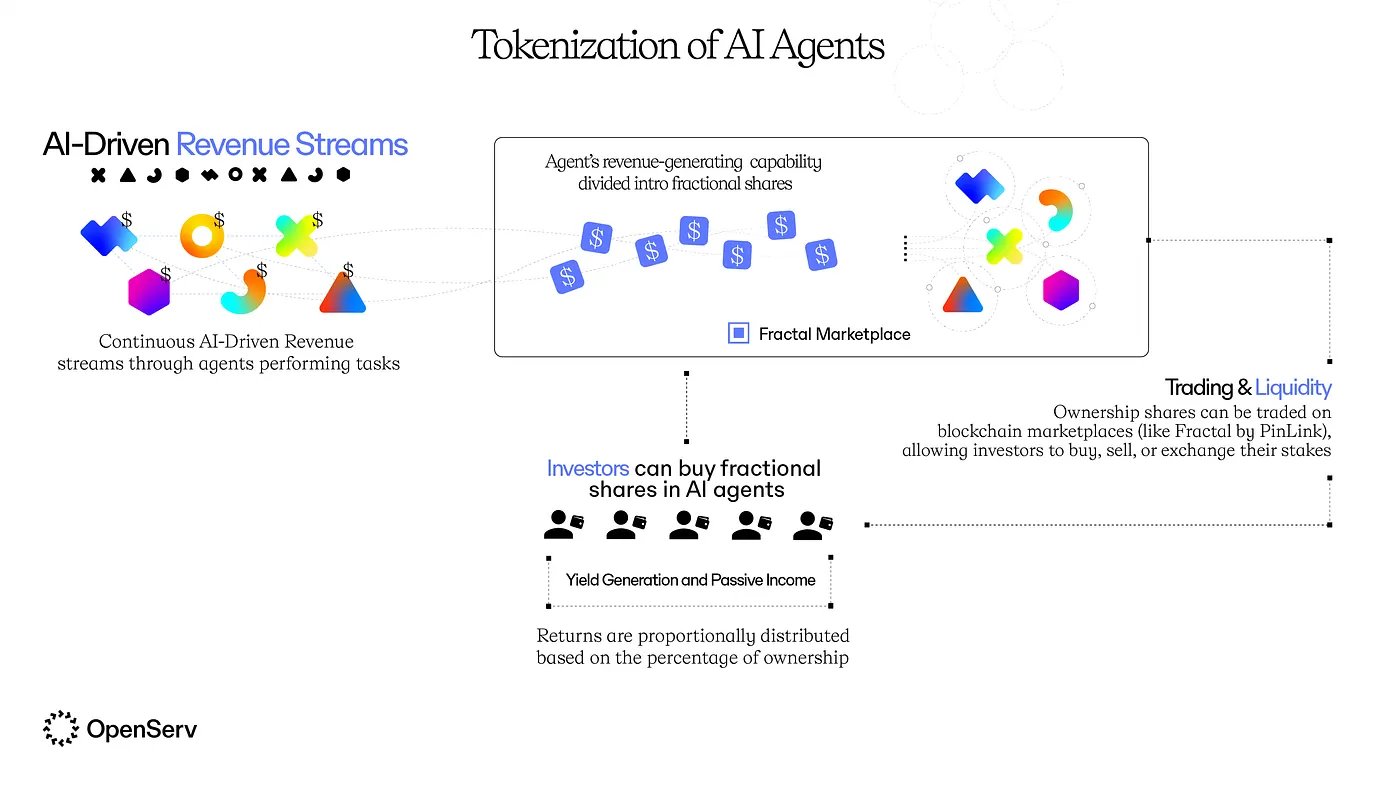
1. Tokenization of AI Agents
- AI agents are tokenized on a blockchain, with each agent’s revenue-generating capability divided into fractional shares.
- Each share represents a portion of the AI agent’s operational rights and future earnings.
2. Investment in AI-Driven Revenue Streams
- Investors can buy fractional shares in AI agents, just like they would buy stock in a company.
- These AI agents perform specific tasks (e.g., marketing automation, trading, data analysis) and generate revenue through their work.
3. AI Agents Operate Autonomously
- The AI agent continuously performs its designated function, generating revenue.
- It reinvests earnings or distributes profits to fractional owners, depending on the setup.
4. Yield Generation and Passive Income
- Owners of fractionalized AI agents earn passive income from the revenue generated by the AI agent.
- Returns are proportionally distributed based on the percentage of ownership.
5. Trading & Liquidity
Ownership shares can be traded on blockchain marketplaces (like Fractalia by PinLink), allowing investors to buy, sell, or exchange their stakes.
Why Fractionalize AI Agents?
Fractional ownership brings several advantages to both AI developers and investors:
1. Lower Barriers to Entry
- AI-powered businesses often require significant investment in computing power, data, and development.
- Fractional ownership enables anyone to invest in AI without the need to build or run the agents themselves.
2. Passive Income Generation
AI agents operate autonomously, meaning users can earn passive income from revenue-generating agents in marketing, finance, customer service, and more.
3. Increased Liquidity
Unlike traditional AI businesses, which require full ownership and operational expertise, fractionalized AI agents can be bought and sold easily, providing liquidity for investors.
4. Democratizing AI Access
- AI technology and its benefits are often concentrated among tech giants.
- Fractional ownership allows individuals and smaller businesses to access AI-generated revenue streams.
5. Scalable & Autonomous Growth
Many AI agents use auto-compounding and reinvestment strategies (as seen in PinLink’s Fractalia model), meaning fractional owners benefit from continuous value growth.
PinLink & OpenServ: Pioneering AI Fractionalization
Platforms like PinLink’s Fractalia Marketplace and OpenServ’s AI Agent platform are pioneering fractionalized AI ownership models.
PinLink’s Fractalia fractionalizes AI agents that invest in DePIN (Decentralized Physical Infrastructure Networks) assets using AI-driven strategies. These AI agents manage decentralized cloud storage, computing power, or physical infrastructure investments, generating passive DeFi yields. By leveraging fractional ownership, users can invest in DePIN without the need for direct management or large capital commitments.
OpenServ is the first partner to fractionalize AI agents on Fractalia, making AI-powered revenue generation accessible to Web3 users.
Together, these platforms unlock a new asset class — AI agents as tokenized, revenue-generating investments.
The Future of Fractionalized AI Agents
The rise of DeFAI (Decentralized Finance + AI) and tokenized AI assets signals a shift in how people own, operate, and profit from AI. Instead of a select few controlling the future of AI, fractional ownership enables collective participation in AI-powered economies.
Fractional AI agents represent the next evolution in decentralized AI-driven business models — allowing anyone to invest in the future of autonomous AI.
Footnotes:
1. OpenServ achieves state-of-the-art performance on SWE-bench Verified, which evaluates AI models’ ability to solve real-world software issues. See the appendix for more information on scaffolding.
2. OpenServ AI understands customer history1 and context to offer tailored responses.
3. OpenServ achieves state-of-the-art performance on SWE-bench Verified, which evaluates AI models’ ability to solve real-world software issues. See the appendix for more information on scaffolding.
🍔 Our Publications
Announcement
Why Founders Need to Build, Launch, and Run with AI
December 17, 2025
Tech Insight
BRAID is the Missing Piece in AI Reasoning
September 5, 2025
Announcement
Introducing Browser Use: A Massive Unlock for OpenServ Agent Teams
July 1, 2025
Announcement
OpenServ’s Road to a New Agentic Economy
June 24, 2025
Tech Insight
Introducing Shadow Agents: The Invisible Game-Changer in Agentic Collaboration
January 2, 2025
Tech Insight
Technical Insights on Multi-Agent Systems and Autonomous AI
November 2, 2024